
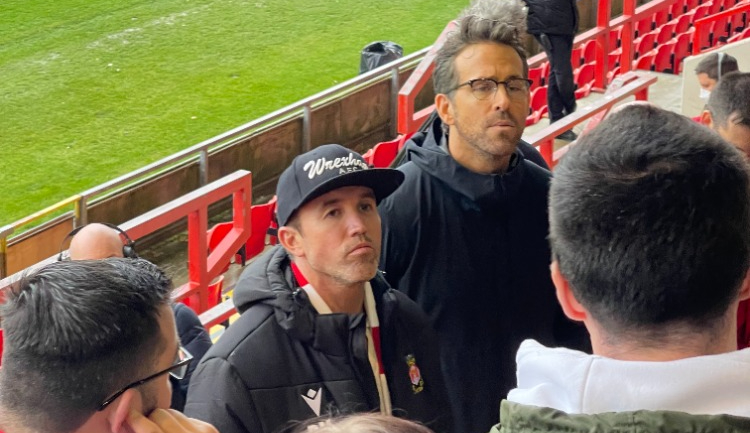
The most boring, and yet also the most understandable, question that I’m asked is “Why did they buy Wrexham?”
As you might imagine, I get asked it quite a lot!
Of course, those of us who have any connection to Wrexham AFC know the long tale of why Rob McElhenney and Ryan Reynolds bought the club we love.
However, I do understand the confusion and bewilderment that it has led to among a wider audience.


I also understand, although I am much less sympathetic towards, the widespread simplification of the tale. For example, at a recent Wrexham game a visiting member of the press proudly showed me the list of Hollywood movie clichés that he had prepared prior to the match.
Some lucky player would be announced as “Best Actor”, the winning manager would be proclaimed “Best Producer”, and he had lined up a veritable Hollywood walk of such banalities. He didn’t seem to understand that my nomination of Christian Dibble for “Best Grip” was sarcastic.
So, it’s inevitable that people ask why our owners bought the club when they’re hardly getting the straight story from much of the media.
However, if people do want to know why they bought into the club, they need only consider what I experience this week.
I decided to commemorate the remarkable 6-5 win over Dover athletic with a documentary of my own. Entitled “A Day Like No Other”, it premiered on Wrexham’s YouTube channel this week. Its intention was to chart the day through the experiences of the people involved.
When I say the people involved, I don’t draw a line at the touchline. The fans experienced at match as much as the players, perhaps even more so!
The process of interviewing fans players and media was fascinating. A common thread combined all the contributions: a deep, emotional passion for the game and for the clubs they love.
I spoke to Wrexham supporters who listen to the game in New Zealand and Texas, and I know that many more listen and interact with us from all around the globe every time the Red Dragons set foot on the pitch.
They, as much as the fans in the stadium who went wild with every goal (including me, I’m embarrassed to say!), experienced the rise of emotions throughout that glorious hour and a half.
The experience of listening to their testimony brings me back to the owners. Famously, Rob McElhenney fell in love with football by watching games on Humphrey Ker’s laptop during breaks in writing sessions for “Mythic Quest“.
He was attracted not only by the excitement of the game – in a way that was the least important factor – as much as he was by the thrill of the crowd.
He has said that he recognised in the faces of Wrexham fans the working-class supporters of the Philadelphia Eagles when they celebrated winning the Super Bowl.
He saw, as well, the potential to unite, support, and energise a community when Ker told him of the rich social history of the game and the roots that clubs put down.
Talking to those fans, I saw exactly what he meant. They spoke of sharing the emotion with their friends and family. Or, regretted not having someone to share those feelings with, due to distance.
They spoke of the value of social media in binding a disparate community.
Most of all, they spoke of the love that the game can engender, in people, in places, in institutions.
Barcelona claim they are more than a club. How naive are they? Every football club is more than a club, and Rob and Ryan spotted that from the outset.




Leave a Reply