
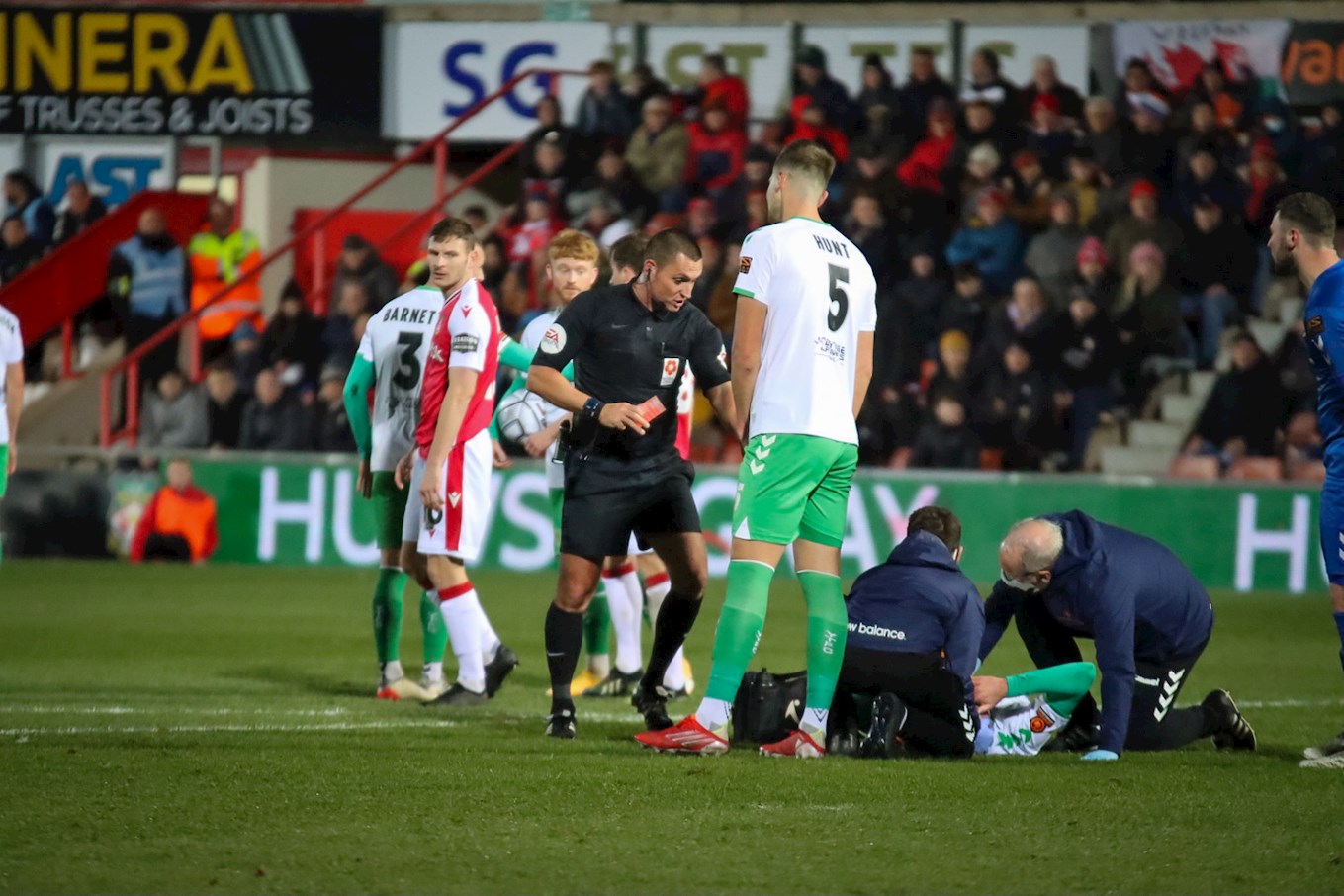
I have the utmost sympathy with referees. It’s a heck of a tough job, they get abuse nobody deserves, and they only get one shot at seeing an incident before making a decision.
I’m tempted to have a good gripe about them, because an extremely harsh red card on Tuesday completely turned our match against Yeovil. However, as I’ve thought about it, I’ve realised there are two types of error a ref can make, and although I think Tuesday’s official was wrong, I’m going to back him up. I’ll get to the other type of error later, and won’t be so charitable!

The decision in question went against Liam MacAlinden, who was dismissed for an elbow to the face of a Yeovil defender. He definitely jumped into him, as he arrived late to contest a header, and it was definitely a foul. But was it an elbow?
From watching it live from a pretty close vantage point, and seeing two other angles on the footage, I’m really not convinced he did anything sinister. It certainly felt harsh considering the elbow in the face Jordan Ponticelli received 5 minutes earlier: when he required treatment after an outstretched arm caught him in the face. That wasn’t a red card offence, though, and MacAlinden’s certainly wasn’t.

However, I have to concede that the referee had just one chance to see both incidents and make a decision. He made the wrong decision, but it was made in good faith and we simply have to accept it.
Are too many poor decisions made at National League level? Sadly, the answer is clearly yes. Are those decisions corrupt in any way? Absolutely not. We have found ourselves in the fifth level of the pyramid, and have to accept that one of the consequences is our referees will be fifth grade too. That’s just life, and if we want it to change, we need to get promoted.
Some decisions do astonish at this level: Bryce Hosannah’s dismissal at Maidenhead, even though he was some distance away when Paul Mullin actually committed the foul, was a real jaw-dropper! The issue with that one is how the ref came to that decision.
Post-match I spoke to some coaches and stewards who were right next to the action, and they seemed to think the officials hadn’t seen what happened, and made a decision based on the damage to the Maidenhead player had been hit in the face.
I understand the desire to deliver justice, but if you can’t identify the culprit, you shouldn’t just pin it on someone who happened to be in the area at the time!
There is, as I said earlier, an unforgivable kind of error a referee can commit though. A classic example is Manny Smith’s red card at Maidstone, back in 2017. The initial decision to award a penalty as he made a tackle in the box was extremely harsh in itself, but as I said earlier, the ref only gets one chance to see it, so I’ll let that go.

What was unforgivable was the red card Smith was shown for denying a goal scoring opportunity, when the laws of the game had been changed that season: a professional foul in the box can only be a red card if the player hasn’t tried to play the ball.
Clearly, the referee did not know the laws of the game he was officiating, and when Mark Carrington told him that, he was sent off too!
That’s the sort of mistake I can’t forgive. Ignorance is no excuse for a ref but to be fair, even when a referee’s decisions warp a game’s outcome, as it did on Tuesday, an honest error of judgement is just something you have to swallow as part of the game.






Leave a Reply