
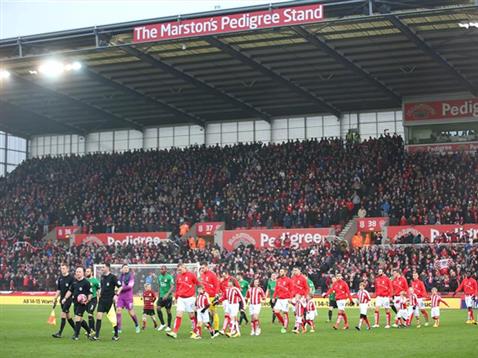
In a season packed full of symbolism, new horizons and old rivalries, next Saturday stands out.
Returning to Stoke ten years after one of the most memorable away days of the century will be emotional.


It kicks off a challenging run of fixtures. That’s a good thing, though.
You aspire to climb the divisions so you can test yourself, and we surely will be in the next few weeks.
We will be facing sides at the top end of the table, heading to stadiums we’ve never been to before, and truly stretching ourselves, which is the only way to discover what your capabilities are.
Throw in a chance to reach the quarter finals of the League Cup and you’ve a lot of exciting opportunities to add to the list of memorable games which our trip to the Britannia Stadium in 2015 is on.
We were mid-table in the National League when we travelled there in the third round of the FA Cup. However, we gave a demonstration of the potential of the club.
Back in 2008, I wrote in the Leader that I feared we would shrink down and become a non- league club if we weren’t able to get out of the fifth tier swiftly.
I was right to be worried, because that’s a process many clubs have suffered, but I was wrong to worry that it could happen to us.
Our indomitable spirit, the remarkable loyalty we inspire, is what Rob and Ryan saw in us, of course, and that January day in Stoke was a clear glimpse of Wrexham’s potential.
Four thousand away fans making terrific noise, roaring in unison, and a performance which threatened to pull off the upset of upsets.
You don’t get non-league teams winning away to Premier League opposition too often, after all! Mark Carrington’s fantastic header made us dream just for a while, though. We led with ten minutes left, and were level in the 87th minute. Stoke had to bring on top internationals like Peter Crouch and Stephen Ireland to deny us.
Tet match was memorable for a tactical plan which we executed to perfection. Coach Carl Darlington was credited with the unexpected approach, which saw Mark Carrington playing behind a striker to lend his athleticism to our pressing and disrupt Stoke’s ability to feed their strikers from deep positions.
Watching a top tier side struggle to work out how we were stifling them so effectively was a treat, especially as it was such a step up from the week-in, week-out drudgery of that season.
The weeks surrounding that game were a stark illustration of how far we’d fallen.
A fortnight earlier we’d lost 3-1 at home to Dartford, less than a fortnight later we were thrashed 4-0 at home by Telford.
The trip to Stoke was shoehorned between two FA Trophy ties: first we’d managed a draw at Southport purely through a remarkable performance by on-loan goalkeeper Jonathan Flatt, who pulled off a string of fabulous saves to earn a replay.
We got through that, but were subsequently two goals down at Stockport, then a division below us, before Louis Moult stepped up to earn another replay.
We’d get to the final of the FA Trophy that season, but as we lost at Wembley to North Ferriby, it was hardly worth the effort!
So that Stoke match was an outlier, a relief from the grind of our diminished circumstances. A break from the reality of our non-league status: our previous league match had been our three hundredth in the fifth tier, which showed how established we were at that level.
Even our approach to the game was unique, as was the level of our performance. This time it’s very different, which is what makes Saturday such a good point to reflect on how far we’ve come, and why it’s so deeply rewarding.
Our return to Stoke as equals is a wonderful story, and it appeals because it taps into the most basic of human emotions.
The ancient Greeks knew it: their drama often revolved around denying your pre-ordained fate. Watching Oedipus struggle to defy the tragedy predicted for him is compelling.
If what they wrote hadn’t tapped into something profound in human nature, it wouldn’t have survived the centuries. We haven’t changed. At the heart of any underdog story is the notion that fate is being denied.
The surprise package shouldn’t really be there, but they are because they fight back against the seemingly inevitable.
We’ve taken it a stage further: we’ve gone swiftly from enjoying a special day out against a big name club to becoming one ourselves.
It’s the sort of fantastical story which authors wouldn’t touch, because it’s too outrageously unlikely. Yet here we are, heading to The Potteries as equals.
Cynics might argue that someone whose dream is to go to Stoke on a Saturday needs to learn how to dream bigger. I don’t think they get it. It’s wonderful that we’re where we shouldn’t be, and we belong there.


Leave a Reply