
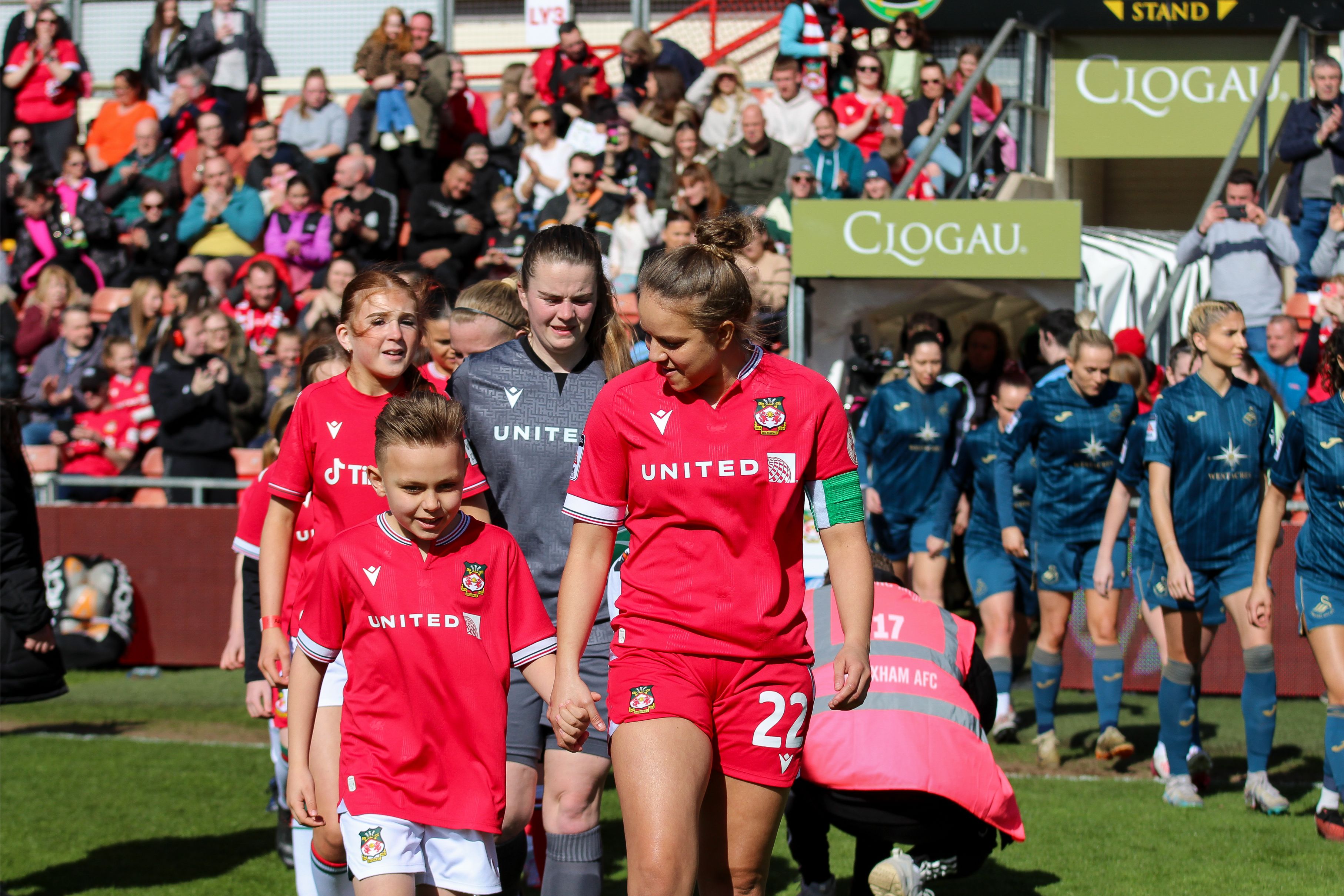
Sunday sees Wrexham start our second season in the top tier of Welsh women’s football. It’s been a remarkable story, and not just because it’s been told to a global audience.
Wrexham’s ambitions and dramatic rise from regional also-rans to top three side have seen us set a record attendance for a women’s game in Wales: it was loudly trumpeted as having been more than twice as large as any crowd for Cardiff, Swansea or the national team; much less well publicised, but more striking to me, was that it was also over three times larger than the biggest attendance for any men’s league match in Welsh history. Wrexham’s eye-catching progress has sparked a wider growth in the game as established clubs like Cardiff City and Swansea City have responded, using their main stadiums more often for women’s games and developing strong sides to see off the threat from the north. The truth is that Wales could end up being the only European country whose women’s league is senior to their men’s if the FAW are able to ride the wave we started. To kickstart that process really would be something to be remarkably proud of.


The fascinating thing about the Wrexham Effect is that the structure of the Welsh game massively restricts the impact Reynolds and McElhenney’s money can have on the team. This is a major problem for Welsh women’s football in one regard: the reason Wrexham can’t splash the cash and become the PSG of the Adran Premier is rooted in a lack of vision and ambition at an administrative level which limits the impact of investment in the women’s game. However, the positive side is that, no matter how much Rob and Ryan want to plough into the team, there’s a built-in limit to what impact their money can have. Admittedly, it’s a limit born from a lack of ambition for the league, and ultimately it’s likely to be detrimental to the development of the game, but for now, settle back and enjoy Wrexham’s attempts to break the glass ceiling and play on an even playing field with the southern giants of the game. It’s exciting to see the women’s team look to succeed because investment is made in infrastructure rather than in buying solutions by drafting in match-winners.
The reasons why Wrexham can’t buy success are quite simple. The history of women’s football in Wales is, in many ways, the exact reverse of how the men’s game developed in the 19th Century. Then, football in Wales was concentrated in the north-east, with Wrexham the hub. The FAW was based in the town, clubs like Druids and Chirk were competitive with teams which are now established as massive presences over the border, and both standards and interest were limited in the rugby-centric south.
As the game slowly developed in the south, jealousy began to sprout. Hard as it might be to believe it now, early southern attitudes were tinged with jealousy as they perceived the north to keep all the big games – cup finals and internationals – to themselves. Up north, we reckon that wrong has been more than compensated for!
In women’s football it’s been the opposite: the south enjoyed more early success, and the make-up of the top division reflects that. As a consequence, having money available is no great help to Wrexham: players in the league are all either semi-professional or amateur, so offering good wages doesn’t necessarily attract talent. If you’re a PE teacher who plays for Cardiff, you’re not going to give up the day job to move north considering the volatility of a career in sport. We might have money to spend, but we’re not going to offer enough cash to be able to encourage established players to uproot. Similarly, buying top division players from the English system is unlikely. Not that we don’t have the money to compete with English teams’ wages: it’s just that the changing room disruption we’d probably cause by paying those fees means it wouldn’t be worth it. Also, beyond an improved wage, what would be the incentive to join? We’d need to improve standards enormously to be competitive in the Champions League qualifiers (take a look at how Cardiff fared in the qualifiers this season for context on that) so playing for a big fish in a small pond would be the only reason to move across. There’d come a point where the lack of challenge would surely become an issue for most players.
What Wrexham have done exceptionally well is raise standards, using the money made available to massively improve infrastructure. The quality of Wrexham’s play has developed massively over the last season, and the incremental improvements could be seen clearly as the season wore on. Week-by-week, fitness improved and passing sequences engrained in training were more apparent. We also were able to challenge the big two more seriously in the closing stages of the season: we took a point from Swansea and were absolutely robbed when we lost our last home game of the season in injury time to them. As for all-conquering Cardiff City, we were magnificent in the Welsh Cup Final, The Bluebirds squeezing out a 2-0 win thanks to an injury time goal.

In Steve Dale, Wrexham have an impressive coach, and turning semi-professional means he can spend more time setting his side up. We saw the benefits in those fine performances against Cardiff and Swansea: throughout the season we’d start well against those sides, Dale having developed specific gameplans to tackle the challenges they presented, but eventually their application would become ragged and we’d be picked off. It was in those late season matches that his team, benefitting from a year of more intense preparation, were able to execute the plans over 90 minutes rather than start brightly only to fade eventually.
There are other benefits from the club’s improved infrastructure has delivered. The impact of Zoe Clair (below) as a fitness coach has been striking: in the first game of last season we lost a lead against 10-woman Swansea deep in added time as our energy levels dipped, and our next home match saw a lively first half performance against Cardiff lead into a collective physical collapse in the last half hour. By the mid-point of the campaign, the improved scope for meaningful strength and conditioning work was kicking in, and we were steam-rolling teams with our relentless running.

We’ve done some smart business in the transfer market too, but the side which did so well last season is substantially the side which was promoted from the Adran Premier. We improved massively, but only three Summer arrivals made more than 9 appearances: the central defensive pair of Keren Allen (22) and Louisha Doran (11, as her season was curtailed by injury) and the effervescent Carra Jones (2). That speaks of good coaching and good preparation.
The challenge this season is to build on what was achieved last season. Coming third in our first season was a superb achievement, and now the task is to narrow the gap to the top two and look to challenge them for the title. A top four spot and a trophy would be fantastic, but Rob and Ryan don’t want to hang around: take a look at the men’s team if you actually need evidence. They’re not unrealistic, but they promised to make us the dominant force in Welsh women’s football, and the sooner they see that happen, the happier they’ll be. They didn’t get where they are today by waiting until tomorrow!




Leave a Reply