

Last Sunday’s loss at Birmingham was a blow. It was unusual to see us fail to bounce back decisively, because it’s something we’ve done exceptionally well under Phil Parkinson.


Our resilience is remarkable under him, and set-backs have been brushed off with astonishing regularity.
We couldn’t manage it at St Andrews though, and failed to lay a glove on our opponents.
There are plenty of facile conclusions that can be drawn to explain what happened, but the simple fact is that, despite the early Sunday kick-off meaning we enjoyed a rare traffic-free journey into Birmingham, we just didn’t turn up!
It wasn’t for lack of effort. There was plenty of heart and determination on display. Anyone who has ever suggested Parkinson’s Wrexham lacked spirit really hasn’t been paying attention at all.

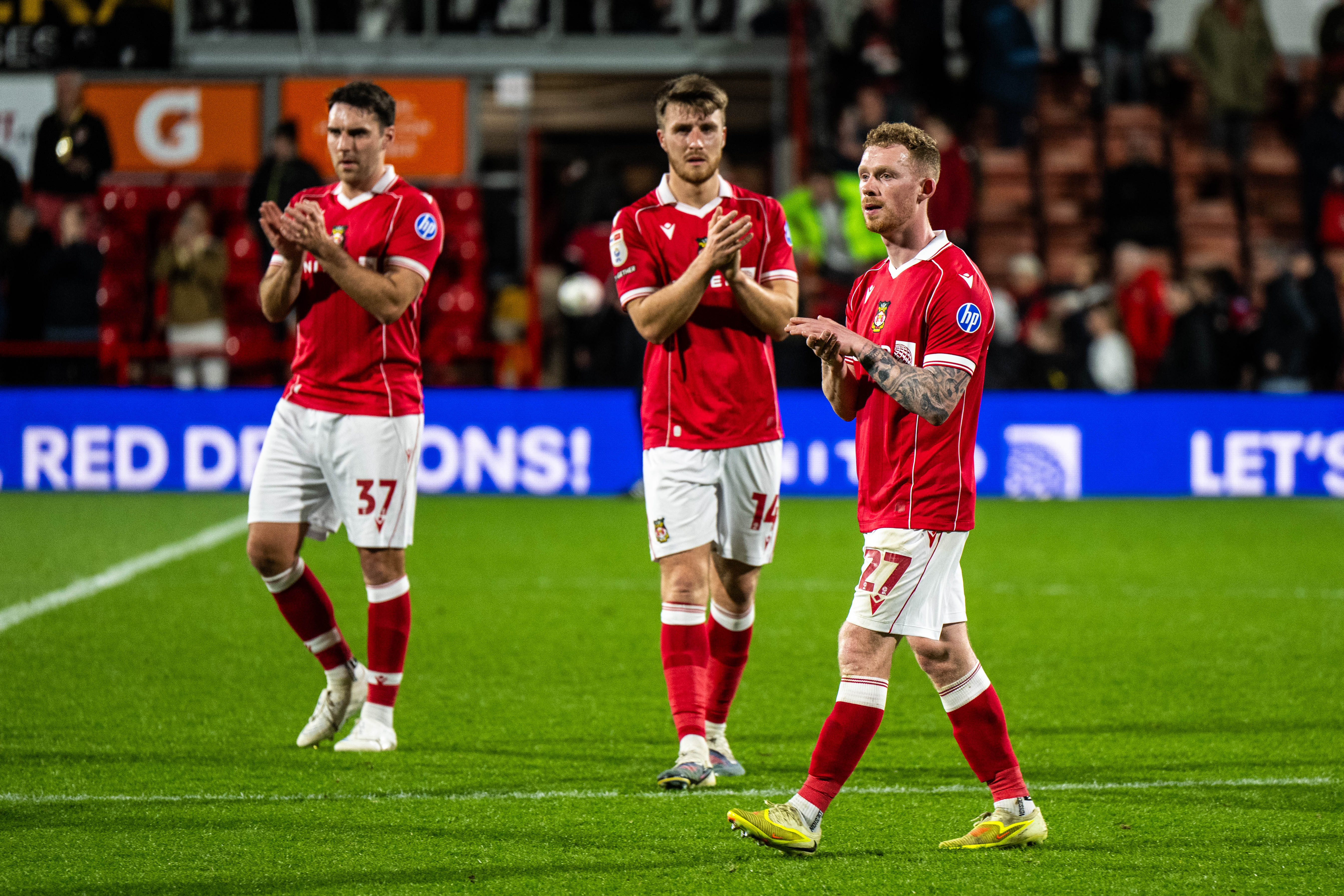
Andy Morrell made a strong point during commentary of the match. He suggested there was a certain wariness in the side after suffering the shock of a 5-1 home defeat.
Players were a little more cautious in their decision-making, recalling the consequences of their errors against Southampton, who ruthlessly exploited every moment of weakness.
That reticence was expressed in many ways.
An opportunity to play a progressive pass not taken for fear of losing possession.
A chance to make a forward run off the ball rejected in case the move breaks down and the space left behind is attacked on the transition.
More aggressive positioning off the ball, designed to pressure the opposition, avoided because one accurate pass could take three or four pressing players out of the game.
There were no disastrous examples of these incidents; no points where our temerity was blatantly costly. However, they accumulated and led to a malfunction in our structure.
Football is a low-scoring game of narrow margins, and when a number of small things add together to take you away from your normal standards, those subtle shifts can lead to collapse.
The ironic thing is that, although we were second best and failed to threaten City’s goal, we really should have got a point out of the match which would have felt very different.
Their goals were certainly avoidable, coming from a poorly defended cross and a corner which we couldn’t dealt with.
The first was particularly galling as there were so many points where we could or should have intervened.
It started out with Bright Osahi-Samuel being forced away from our goal by a two-man press, which he managed to evade with a scuffed pass between his pursuers which shouldn’t have got to its target.
The ball was fed into the box, but August Priske got his return pass all wrong. However, our defensive unit was positioned conservatively so the stray pass inevitably found a City player, albeit not the droid he was looking for!
Then, what turned out to be the assist was aimed at Priske but was overhit; however, Carlos Vicente was more aware of the possibilities a heavy cross presented than the defence and scored with an opportunistic effort which Arthur Okonkwo did well to nearly claw out from behind the line.
So, we could have ended up with a clean sheet and a close scrape rather than a 2-0 loss. As it was, we just couldn’t get the momentum going to threaten City with a comeback.
It wasn’t for want of trying by the bench. We rang the changes from an attacking bench and ended up playing an aggressive formation which resembled the 4-2-2-2 Brazil play when they are trying to pack a series of creators onto the pitch.

Ironically, being level at half time might have hampered us. If Vicente had not been denied in added time at the end of the first half by a fine save from Okonkwo, Parkinson would have had a chance to encourage the players to release the handbrake at half time.
It’s tempting to think we over-corrected after conceding five goals on Tuesday. Tempting, but wrong.
Yes, Parkinson talked of going back to basics and going at Southampton too aggressively, but our lack of attacking bite at Birmingham wasn’t down to that.
Admittedly, the make-up of our midfield was substantially altered. We replaced Josh Windass and Nathan Broadhead with Ollie Rathbone and Lewis O’Brien, being the number tens in our box midfield were hard-running midfielders rather than playmakers.
That doesn’t mean we would inevitably lack creativity though. That duo were used in that configuration at Blackburn in January and we won comfortably with their energy defining our performance as we pressed high and made it difficult for Rovers to play out of their own half.
Our failure to replicate that performance lends credence to Morrell’s theory. We had a side which was set up to get into Birmingham’s faces and make life difficult for them, but an air of caution meant we didn’t manage to do that.
With our midfield deeper than you’d wish, Kieffer Moore was left isolated and we retreated into a wariness which proved fatal.
In this perfect storm of unfortunate circumstances, Birmingham turned out to be the worst possible opponents. Pre-match one might have drawn the opposite conclusion: after all, they were on a run of losses and had nothing to play for.
However, their manager Chris Davies had rotated his side on Monday, bringing in players who had something to prove having not been in the side in recent weeks. They were unlucky to lose at Ipswich but picked up where they left off.
They have suffered a poor season, but Davies is a good organiser and they have rarely been overrun. Our restrained approach, married with a compact opposition which denied us space and made us see the danger of every run, every pass, led to an impasse when we had the ball.
We paid a heavy price, but despite not being able to bounce back from a defeat, my opening point is still relevant. We do respond well to set-backs. We’ll just have to do it a game later than usual this time.
Leave a Reply