

 Before the Dagenham game I decided to look out for what Bryan Hughes had done to change Wrexham’s strategy. I soon realized that this intention only showed how stupid I am.
With hardly any time to work with the team before the game, Hughes had very little opportunity to implement any philosophy he might want to impose on the side. There was no real scope for him to establish any new approach he might have formulated after so little time on the training pitch. However, there were a few small signs of something different evident on Saturday.
The first was something which was definitely new, and was clearly a work in progress. It was perhaps surprising too, considering the problem Graham Barrow correctly identified of us being too slow in getting the ball forward, and allowing the opposition to get their defensive shape sorted, forcing us to pass the ball in front of them.

Hughes’ initial attempt to address that problem was counter-intuitive, but might be a clever way to get the best out of the players at his disposal. There was a lot more passive passing when the ball at the back, as the centre backs rolled it between each other without looking to pass into midfield to initiate an attack. This might seem a peculiar response to the slowness of our build-up play, but it was actually an interesting idea: they were clearly waiting for triggers up front before delivering a long ball. Ben Tollitt and Bobby Grant would wait for the right moment and then, having dropped deep, make darting runs over the top, prompting a long ball for them to run onto; the passive passing had drawn Dagenham’s defence forwards, creating the space for the wide strikers to latch onto.
The approach didn’t yield any concrete results, and was much less evident in the second half as we took control of midfield and forced Dagenham back anyway. However, it was something which will be worth pursuing once the team have had more time to practice it, not least because it looks like a good way to bring Tollitt and Grant into play with a bit more space: a goal-shy side needs to make the most of these two forwards, both of whom are threatening when cutting in from the flank.
In his introductory interviews, the most interesting thing Hughes said, after watching our recent games, was that he wanted to introduce more fluidity in midfield, and we could see that in the way Luke Young and Akil Wright constantly got into goalscoring positions. I accept that this isn’t necessarily anything new: Young got into the box to score the winning goal against Maidenhead a fortnight ago, and as early as the first game of the season I was arguing that his ability to break through the lines and get beyond the striker could prove useful.
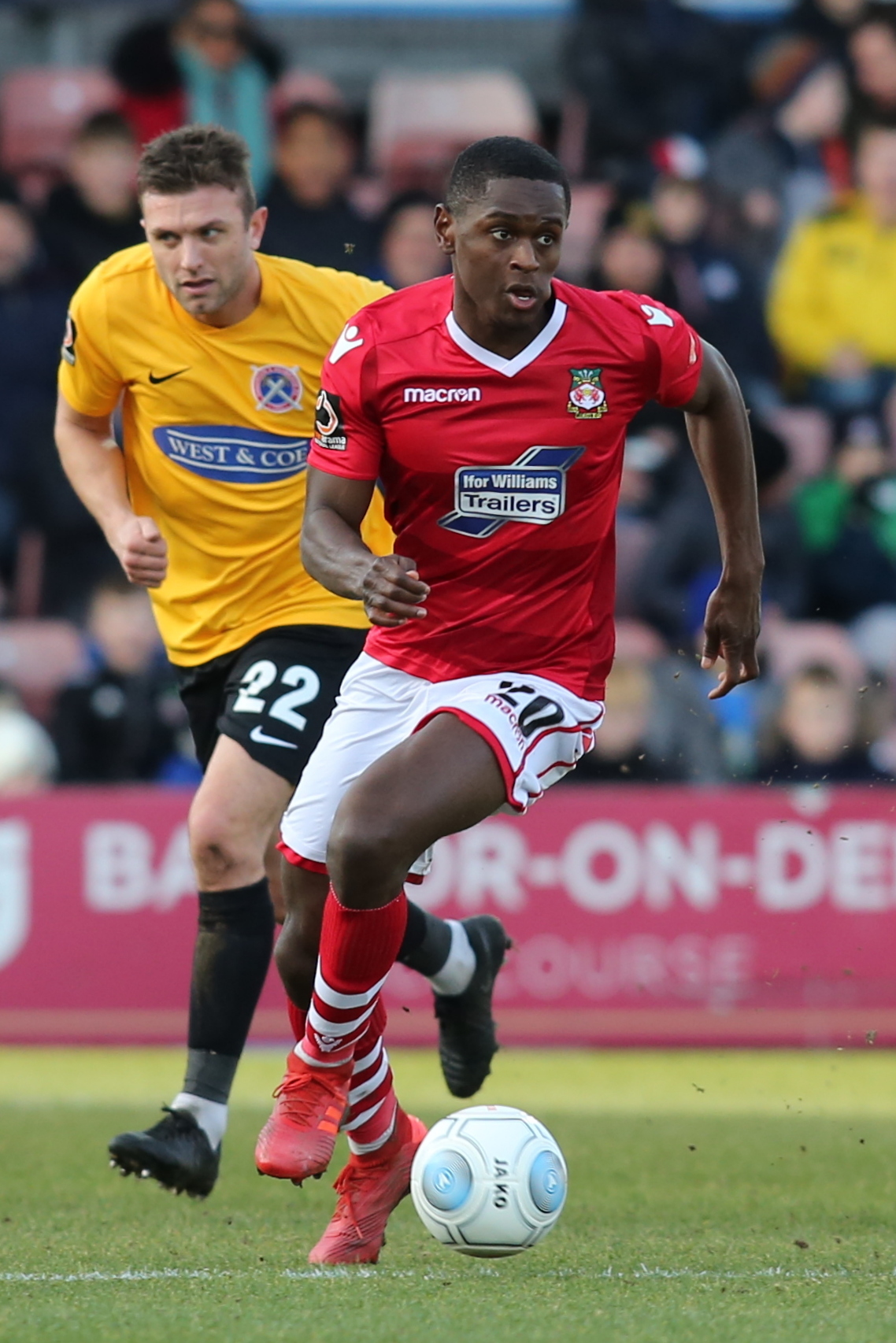
However, nobody could disagree that we created more chances for midfielders than we have for a very long time against Dagenham; it was just a pity that the majority of them fell not to Young, but to Wright, an admirable midfielder whose composure in the box is not his strongest suit.
Perhaps this was a consequence of our midfield being a little higher up the pitch in the second half, but Wright was looking to run beyond Tollitt into the half spaces on the left side of the box in the first half. Instead, I think it was a conscious effort to make our midfielders get into more threatening positions.
We’ve been a very highly-structured side for the last couple of seasons, with a heavy emphasis put on team shape. This has proven to be a double-edged sword: we’ve benefited through the creation of a remarkably effective defensive unit, which set a club record for the most league clean sheets in a season in the last campaign, and is on course to break the outright clean sheet record in this one.
However, the downside has been difficulty in transitioning from that defensive shape into an attacking one. Last season we were very rigid in our 4-4-2, rock-solid defensively but awkward going forward. This season we’ve loosened up a bit but Hughes might be the man to really take a gamble with the amount of fluidity he allows his midfielders.
It’ll be interesting to see where Luke Summerfield fits in when he returns to fitness: will Hughes be tempted to use him as a deep playmaker, retaining the forward thrust of Young and Wright and doing away with the defensive cover provided by a midfield anchor man?

Whatever he does, I’m becoming intrigued. It already appears that Hughes’ time watching our previous games was well spent, as he has correctly identified some fundamental issues which need to be addressed. You might argue that it was only common sense to give Tollitt a chance and encourage our midfield to be more forward-thinking. But don’t underestimate the value of common sense: the smartest thing Andy Morrell did at the start of his time as manager was recognize he’d inherited a well-organised unit and resist the temptation to tinker with it too much.
If Hughes continues to make sensible alterations, he might prove to be an inspired appointment; we’ll probably have a clearer picture of what his overall strategy is after the game at Havant.




Leave a Reply