
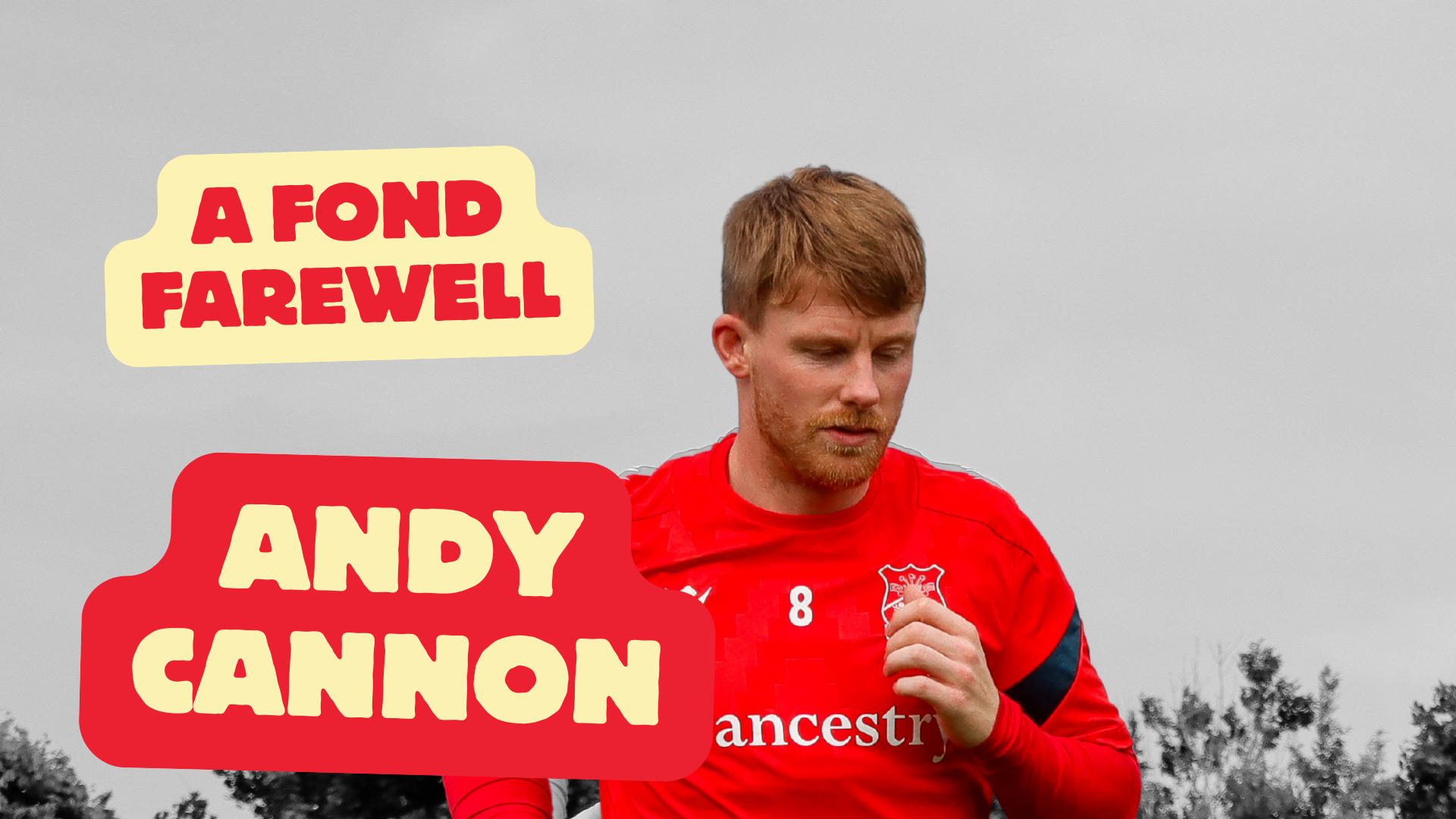
A FOND FAREWELL
Over the next fortnight we’ll pay a daily tribute to one of the players who are leaving Wrexham AFC this month.
Of all the Summer departures from the Racecourse this Summer, perhaps the cruellest is that of Andy Cannon. We’ll never know how his Wrexham career would have panned out were it not for that horrible injury he picked up at Field Mill.


Plenty of players who shone in League One were discarded as we gathered together a squad capable of challenging for a spot in the Premier League. Maybe Cannon would have been one of them, but he showed enough to suggest he might have transitioned successfully, like Ollie Rathbone and George Dobson.
He arrived in December 2022, taking advantage of that one season when we were allowed the same window-free experience as the rest of the National League. He already had pedigree as a player who had won the division at our expense the previous season with Stockport County, for whom he’d started against is in the FA Trophy semi-final at The Racecourse which was decided by Paul Mullin’s late double intervention.

His next appearance in Wrexham, having not got off the bench for the 3-0 beating we handed out to County a month later, was in a red shirt, setting up a goal in that bizarre FA Trophy match against Scunthorpe United which started late because the visiting team arrived later than their fans!
It was immediately obvious that he brought hustle and energy to the team but, as usual with Parkinson, he certainly wasn’t rushed into the first eleven. As his assimilation into the Parkinson Way was delivered in training, he was only selected in one of the next six games – an FA Trophy elimination at Altrincham – and didn’t even make it onto the bench except for the FA Cup shock at Coventry when Parkinson took advantage of the extra substitutes he could name in that competition. When his league debut did come, in a 3-0 win at Gateshead, it was brief: he came on in the 90th minute! He simply had to trust the process and wait for the manager to judge him to be ready.
His next start was at Bramall Lane, when Parkinson rotated heavily for the replay against Sheffield United, and he showed once more that he had the right attributes to add quality to the side, playing in a position on the left of the midfield three which he would rarely fill again. However, he would not be so effective in the role against very different opposition in his next start, a 2-2 draw at home to Woking.

James Jones replaced him and, although he was usually used on the right side of the midfield three, he filled the role much more effectively as his more narrow range of passing was less important than his superior physicality.
Cannon clearly had quality though, and Parkinson’s reign has been characterised by his strong work on the training ground. A recalibration was necessary, and it was clearly affected successfully because when Cannon was reintroduced into the team it was in the centre of the midfield three. Despite sometimes being lazily described as such, that role is rarely a straight defensive midfielder, and Cannon’s speed and ability to press complemented his swift decision-making, meaning he was often the most advanced midfielder, pushing up to win the ball back and create. His reading of the game and timing of his tackles meant he was a useful weapon in forcing turnovers and passing accurately once possession had been regained.
He revelled in the subtle shift in his position, and Parkinson’s faith in him was unequivocal. He became an indispensable part of our run-in, starting each of the final 14 games of the season in a role which suited him far more. The title was clinched with one game to spare, Cannon played his role in the famous win over Notts County and a total of 32 points won out of 39 after the victory over Boreham Wood which got us over the line suggested the side was ticking over rather nicely with him in it!
The faltering start to the following season was reflected in his form, and although he had plenty of higher division experience and had been brought in as an EFL-ready signing, it was the step up in level which caused the problem. As the central player in a midfield three he was outstanding in the National League, able to spot opportunities to trigger the press and cover ground swiftly to do so, forcing errors against inferior opponents who could be hurried into mistakes.
In League Two this was less easy. Better technical players were able to pass their way around and through us, bypassing Cannon’s pressing and leaving him put of position. Forced to do more work in his own half, scrapping for the ball, he struggled against more physical midfielders. He relied on the timing of his tackles, but his technical superiority wasn’t the percentage option; while he was strong, his wiry frame was not allowing him to win enough of the ball against players with height and weight advantages who played on those qualities, and aerially he was outgunned. Cannon struggled to break play up or find time on the ball in congested central areas.
He started three of the opening four league matches but didn’t find his rhythm and after being withdrawn after an hour of the League Cup defeat against Bradford he lost his place to new signing George Evans, a player who, as well as being technically adept, also had the physicality of a central defender.
Just two substitute appearances in the next seven games, one of which was in the final minute, followed before he looked to have potentially brought his spell at The Racecourse to a premature end. Brought off the bench after an hour at Crawley as we struggled to defend a 1-0 lead, he would last just six minutes. He was clearly desperate to make an impression and was haring around the middle of the pitch with terrific eagerness, but jumped over-zealously into a challenge and was shown a straight red card. Despite his horror, it was a reasonable call.
It was a low point, and although we held on for the win, plenty of fans were running out of patience with Cannon. He played the next game and did well in a 3-0 win at Crewe in the EFL Trophy, before his three-game suspension kicked in. Once more, Parkinson’s shrewd judgement would come into play though, as Cannon was surprisingly introduced straight into the starting eleven once he was available again. The fans were surprised, but Parkinson had the advantage of seeing how Cannon had reacted on the training ground, and was richly rewarded as Cannon starred in a fine 2-0 win at Notts County, making his first assist for the club. He followed that up with a similarly impressive performance at Mansfield, setting up another goal as we won 2-1.
He was back in a wider midfield position, but this time on the right, where a natural ability to link with the overlapping wing-back and his vision and intensity off the ball meant he began to have the same impact in the opposing half as he did in the previous season. Furthermore, he swiftly showed himself to be an accurate crosser of the ball and a goal threat now he was in a position to better exploit those abilities.
In what turned out to be a depressing foreshadow of his final performance, he went off injured at Mansfield with what looked like a serious injury. On that occasion his luck was in and he was back in the team and instantly picked up where he left off with two assists against Morecambe and then his first two Wrexham goals in consecutive matches. After no goals or assists in 26 Wrexham games since his debut, he’d managed seven goal involvements in five matches.
Once again he was a regular in an elongated run-in. Above rotation, the Morecambe game began a run of 31 games to the end of the season of which he missed just two: he was rotated once in the EFL Trophy and was injured for a league game. He got results, in both senses of the phrase. Two fine strikes at Grimsby secured a comfortable 3-1 win as we responded to a rough week in typical fashion. Heading round the final bend, we’d dropped five points at home in a week, but the win at Blundell Park was the start of a superb run-in: we lost one and won all the rest of our eight remaining games to clinch promotion. Cannon chipped in with five goals and an assist; he contributed one of each in perhaps our outstanding performance of the season, a 4-1 win over in-form Crawley Town with three games left.
He continued to be central to our plans in League One, starting last season as a regular starter. A rare substitute appearance at Charlton saw him score within a minute of coming on, capping a fast break with the goal which would have been the winner if it wasn’t for an abysmal penalty decision in the 98th minute.
The emergence of Ollie Rathbone after a Cannonesque period of assimilation and the arrival of Matty James squeezed Cannon out of his regular place in the first eleven, and he was omitted from five league games after being withdrawn in the loss at Shrewsbury, but he kept his hand in with EFL Trophy goals against Port Vale and Bolton in consecutive midweeks. That led to a fateful recall at Mansfield and the horrible injury that ended his Wrexham career.
There’s no obvious reason why he wouldn’t have gone on to maintain his standards in The Championship, and continue to contribute to a project he joined at the ground floor. His enthusiasm and professionalism made him popular with fans, coaches and players alike.
And, just to go on the record with this, I think he did see a lion on the M62. My dad saw one in the Beastmarket when he was a kid1 so why can’t one have been prowling the motorway system of Northern England?



Leave a Reply